Every family needs a few creative projects that are just for the grown-ups, and homemade French macarons are mine. These delicate almond cookies have a reputation for being fussy and difficult, and honestly, that reputation is earned. But that is exactly what makes macarons such a satisfying challenge. After more than 30 batches, I have learned that the secret is not talent, it’s precision. Once you reduce the macaron baking process to a series of exact, repeatable steps, these sweet, colorful, picture-perfect cookies become surprisingly achievable. Here is everything I have learned about making easy French macarons at home.
A quick note before we start: This is a project for adults and older teens, not a kids’ baking activity. Macarons are temperamental and depend on careful technique, so they are best made when you can focus. Think of it as your creative escape once the little ones are in bed, or a fun challenge to master with a friend.

Why Macarons Are Worth the Effort
Macarons are sweet and colorful, and it feels like a success to pull a tray of perfectly risen shells with lacy feet out of the oven. Once you master the technique, you can make them in practically any color and flavor. Macarons make any gathering feel a little fancier, whether it is a birthday, a holiday, or afternoon tea. Best of all, mastering this easy French macarons recipe is its own reward! Below, I share three fillings to try: sweet cream, buttercream, and chocolate.
Macaron Baking Supplies
Precision tools are what make macarons work, so a few specific supplies are worth having before you start. I had to buy a food scale, a flour sifter, and silicone baking mats, and each one earns its place.
- oven thermometer
- food scale
- flour sifter
- mixer (I use a hand mixer)
- glass mixing bowls
- baking sheets
- icing bag and large round piping tip
- silicone baking mats (or parchment paper)

Oven thermometer – Make sure your oven is set to exactly 300 degrees. Too hot will burn the macarons, and too cool will not cook them through.
Food scale – You must measure the ingredients precisely in grams for each batch to succeed. Macarons are temperamental and are easily ruined by too much liquid or moisture in the batter.
Flour sifter – The almond flour and powdered sugar must be sifted together twice to achieve perfectly smooth macaron tops.
Mixer – You will need a mixer to whip the egg whites to a fluffy, stable consistency, which takes about 10 minutes. A hand mixer works well, though a stand mixer would make it easier.
Glass mixing bowls – Glass cleans more thoroughly than plastic. Use a spotlessly clean glass bowl for the egg whites, because a plastic bowl may hold oil residue that destabilizes the meringue and causes the recipe to fail.
Icing bag and large round piping tip – When the batter is ready, use these to pipe evenly sized macarons. Apply even pressure and count to 3 for medium macarons or 4 for large.
Silicone baking mat – A baking sheet lined with a silicone mat helps macarons set and bake evenly, giving you round tops and lacy feet.

Homemade French Macaron Ingredients
- 100 grams almond flour
- 100 grams powdered sugar
- 70 grams egg whites
- pinch of cream of tartar
- 50 grams sugar
- gel food coloring
- flavoring
The Science of Macarons: 3 Steps to Master
I have had the most success by reducing this recipe to three precise actions. Master these and everything else falls into place:
- Accurately measure every ingredient in grams.
- Whip a stable egg white meringue in a spotlessly clean glass bowl.
- Gently fold the meringue into the dry ingredients to reach the perfect lava-like batter consistency.
Once you have these three down, you have room to play with colors, flavors, sprinkles, and accents. Here is how each step works in detail.
Step 1: Sift the Dry Ingredients
Using the food scale, measure 100 grams almond flour and 100 grams powdered sugar. Sift them together into a bowl. Each time you sift, you will end up with about 1 tablespoon of large almond grains, which you can discard.
Tip: I usually start with 115 grams of almond flour to make up for those discarded grains, which brings my sifted total back up to 100 grams.


Step 2: Whip the Egg Whites
Make sure you are using a spotlessly clean glass bowl. Wash it with dish soap and water if you are unsure, and wipe it dry, since any grease will interfere with the meringue.
Measure 70 grams of egg whites, which is just under 3 eggs. Carefully remove each yolk as you crack the eggs, and do not use the full 3 eggs’ worth, because too much liquid will throw off the recipe. Measure 50 grams of sugar and set it aside.
Using a hand mixer on medium speed, whip the egg whites into a froth. Add a pinch of cream of tartar and keep mixing. Add the 50 grams of sugar one teaspoon at a time, holding the mixer in one hand and adding sugar with the other. Take your time, because adding sugar too quickly will cause the egg whites to fall.
Once all the sugar is in, turn the mixer up to medium-high and continue until the egg whites reach stiff peaks, about 4 to 5 minutes more. As you get close, check often by turning off the mixer and lifting the beaters to see if stiff peaks hold.

Add Gel Food Coloring and Flavoring
Once you have stiff peaks, turn the mixer to medium for a few seconds, then off. Add a few drops of gel food coloring and a few drops of a concentrated flavoring or extract, then mix on medium until the color is fully incorporated.
Use gel food coloring, not regular liquid coloring. Regular coloring adds unwanted liquid that can keep the macarons from rising properly or cause them to crack.

Step 3: Mix the Batter with 50 Cutting Strokes
This is the trickiest part of making homemade French macarons: combining the meringue with the dry ingredients. Gently scoop the whipped egg whites into the bowl of dry ingredients.
Take a spatula, scrape the sides of the bowl, then cut through the middle. Use this gentle scrape-and-cut motion to fold the ingredients together for a total of 50 strokes, keeping a steady rhythm. The batter starts thick and thins as you stir.
At 50 strokes, check the consistency. Dip the spatula in and drizzle some batter back into the bowl. It should run like a ribbon with a lava-like flow, and the drizzle should melt back into the surface within about 10 seconds. If the edges do not blend in that time, give it a few more strokes.

Pipe the Macarons
Fit an icing bag with a large round tip and stand it in a tall glass to make filling easier. Fill the bag, twist off the end, and begin piping.
Line a baking sheet with a silicone mat, which makes perfectly round, evenly baked macarons far easier than parchment paper does. Apply even pressure and count to 3 for medium macarons or 4 for large. Pipe circles slightly smaller than your intended size, since the batter spreads. Once the tray is full, tap it firmly on the counter a few times to release air bubbles.

Dry the Macarons
Let the piped macarons dry undisturbed for 30 to 40 minutes. They are ready to bake when they feel dry to a gentle touch. Skipping this step will cause the tops to crack in the oven.
Bake at 300 Degrees
Bake at 300 degrees for 15 minutes. The macarons are done when the tops are no longer sticky. It is exciting to watch through the oven window as they rise and form their lacy feet!
Remove them and let them cool on the baking sheet. Once cool and firm, gently peel each macaron shell off the mat and move it to a cooling rack.

Homemade French Macarons Filling
Sweet cream is my go-to filling for homemade French macarons. It is richer than buttercream and tastes more authentic to me. This is my own version of a recipe from a French pastry chef, adjusted through trial and error.
Cooked Sweet Cream Filling
- 1 cup heavy cream
- 1/2 cup sugar
- 2 tbsp. cornstarch
- gel food coloring
- flavoring
Heat the heavy cream in a saucepan over medium heat until bubbly. Stir in the sugar until dissolved, then add the flavoring and 1 to 2 drops of gel coloring. Briskly whisk in the cornstarch and keep stirring over medium heat for a few minutes as it thickens. Once syrupy, strain it through a sieve into a bowl to remove any lumps. Chill in the refrigerator until fully cool and set. Scoop into an icing bag fitted with a large tip, pipe onto a macaron shell, and gently press a second shell on top.
Store finished macarons in the refrigerator for several days, or in the freezer for several weeks. Defrost frozen macarons by moving them to the refrigerator.
Buttercream Filling
Alternatively, make buttercream filling which you can customize with gel food coloring and flavoring. I typically choose a natural flavoring such as vanilla, orange extract, or freeze dried raspberry powder.
- 1/4 cup butter
- 1 cup powdered sugar
- 1 tbsp. milk
- gel food coloring
- flavoring
Combine the softened butter, powdered sugar, milk, gel food coloring, and flavoring extract. Mix the ingredients with a hand mixer on medium until smooth. Pipe a large dot of buttercream frosting onto a cooled macaron shell and gently press another shell on top. Repeat for the remaining macarons.
Chocolate Filling
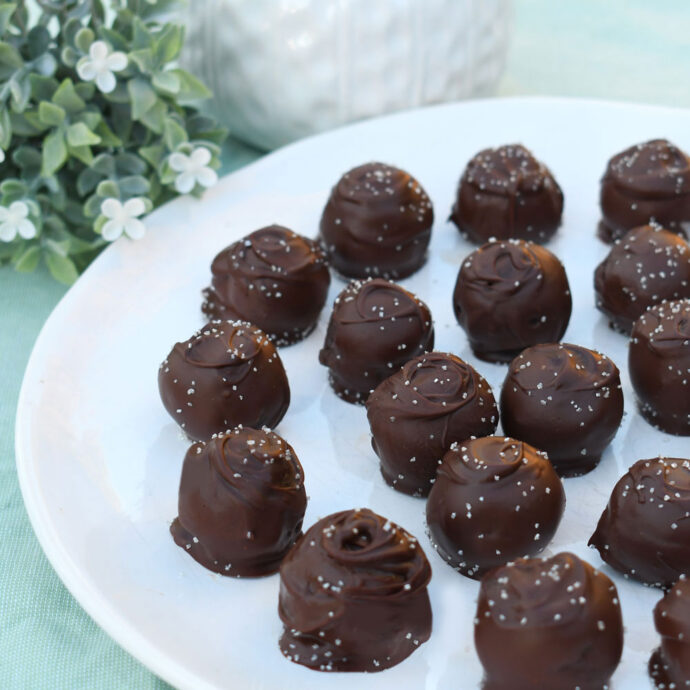
Creamy chocolate filling tastes delicious with espresso or mocha flavored macarons. This macaron filling is similar to my recipe for homemade chocolate truffles.
- 1 cup semi-sweet chocolate chips
- 1/4 cup whipping cream
- 1 tbsp. prepared coffee
- optional flavoring: mint, orange, or vanilla extracts
Heat the chocolate chips in a microwave safe container for 30 seconds at a time, stirring in between heating. Once melted, add the whipping cream and coffee and mix until smooth. Spoon the filling into a piping bag and pipe a large dot onto a cooled macaron shell. Gently press a second shell on top. Repeat for the remaining macaron shells. Allow your homemade French macarons to set for an hour before serving.
Troubleshooting: Oh No, What Happened?
Even after 30-plus batches, mine sometimes still do not turn out. Macarons are sensitive to moisture, overmixing, undermixing, drying time, and oven heat. Here are the problems I ran into early on and what causes them.

Cracked tops – This happened when I used a flavoring with too much liquid. Weigh the effect of every extra ingredient you add, since even a little liquid can throw off the recipe.
Rippled tops – Uneven tops come from humidity, undermixing, or overmixing. The batter is hardest to control when you are trying to split it into multiple colors or flavors, so I have the most success making a single batch in one color and flavor.
Imperfect shape – I struggled to make round macarons on parchment paper. Switching to a silicone baking mat solved it instantly.
No lacy feet – Macarons will not form their signature feet if the batter is overmixed and too thin. Sadly, you will not know until they bake.

Make Macarons Your Creative Escape
There is something deeply satisfying about mastering a recipe this precise. Macarons reward patience and attention, and once the technique clicks, you get to enjoy the creative part: dreaming up new colors, flavors, and decorations. Make them for parties and holidays, or just to treat yourself on an ordinary afternoon. Any tea party is instantly fancier with a plate of homemade macarons.
Have a question or a macaron story of your own? Leave a comment below, I would love to hear how yours turn out. I hope you try this easy French macaron recipe, or at least as easy as it gets!
Hi, I’m Katie! I’m a homeschool mom who’s traveling the world with my husband and 4 kids. We raised our family in North Idaho and currently live in Mérida, Mexico. I love Jesus, coffee, creative projects, photography, and traveling. I hope you enjoy our creative ideas and family adventures!